
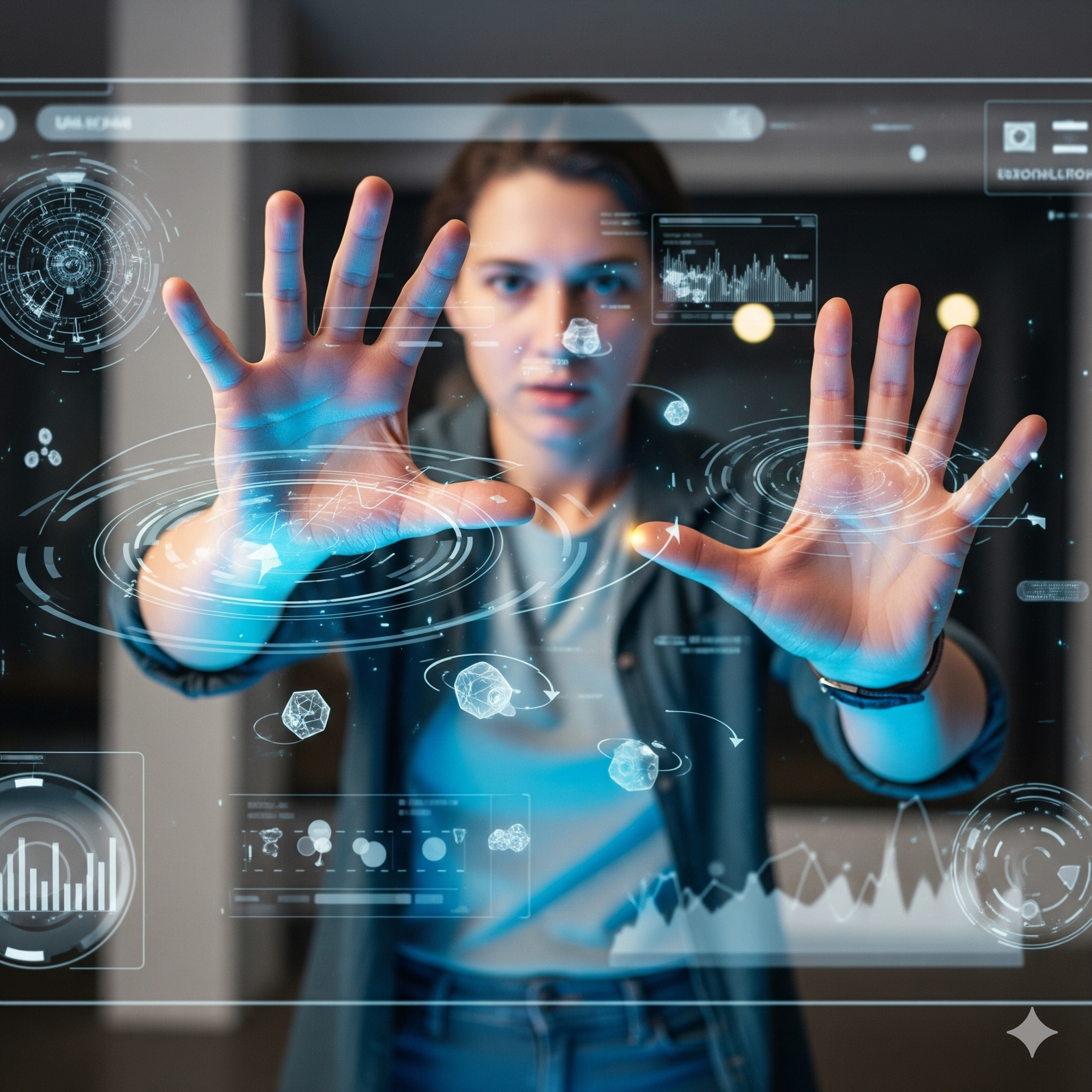
Gesture recognition technology is rapidly evolving, impacting numerous sectors from consumer electronics to healthcare. Here’s a synthesis of recent developments:
Key Trends and Advancements:
- AI and Deep Learning Enhancements: AI-driven computer vision and deep learning algorithms are significantly improving the accuracy and real-time responsiveness of gesture recognition systems. Future AI models promise even more refined gesture detection, leading to seamless and intuitive interactions.
- Haptic Feedback Integration: Combining gesture control with haptic feedback is enhancing user experiences, particularly in augmented and virtual reality (AR/VR) applications.
- 5G-Powered Solutions: Faster data transmission via 5G networks is enhancing the real-time responsiveness of gesture-based systems.
- Applications Across Industries:
- Consumer Electronics: Smartphones, smart TVs, and gaming consoles are integrating gesture-based user interfaces for more intuitive experiences. Wearable devices now feature gesture control for fitness tracking, virtual assistants, and smart notifications.
- Automotive: Automakers are integrating gesture recognition to enhance driver safety by minimizing distractions. Gesture and voice controls in infotainment systems and Heads-Up Displays (HUDs) are becoming standard.
- Healthcare: Gesture recognition is revolutionizing patient interaction with medical devices, enabling hands-free control in sterile environments. Surgeons can manage equipment without compromising hygiene. Touchless sensing technology is also being widely adopted in hospitals to reduce contamination risks.
- Smart Homes: Gesture recognition is becoming a standard feature, allowing users to control lights, thermostats, and other devices with simple hand motions.
- Retail and E-commerce: Touchless checkout kiosks and gesture-based virtual shopping are emerging.
Technological Approaches:
- Vision-Based Gesture Recognition: This involves using cameras to capture and interpret human gestures, with techniques including convolutional neural networks (CNNs), Hidden Markov Models (HMMs), and Support Vector Machines (SVMs).
- Sensor Technologies: Optical, infrared sensors, accelerometers, and gyroscopes are used to capture motion, position, and context.
- Depth Inference: Technologies are being developed to infer depth (z-coordinate) from ordinary 2D cameras for hand tracking and gesture recognition.
Market Growth and Projections:
- The global gesture recognition and touchless sensing market is experiencing exponential growth and is projected to reach \$29.5 billion by 2025.
- It is anticipated to grow at a CAGR of 21.8% from 2025 to 2032, reaching a value of \$117.3 billion by 2032.
Challenges and Considerations:
- Accuracy and Reliability: Ensuring accuracy in diverse environments and accommodating varied user needs remain critical for widespread adoption.
- Implementation Costs: High implementation costs of advanced systems can limit adoption, especially in price-sensitive regions.
- Technical Complexity: Integration issues with existing platforms can slow down deployment and adoption.
- Gesture Variability: Addressing gesture variability, environmental factors, and the need for real-time processing are ongoing challenges.
Commentary:
The field of gesture recognition technology is dynamic, with continuous advancements in AI, sensor technology, and machine learning driving its evolution. The increasing demand for touchless interfaces, heightened by the COVID-19 pandemic, has further accelerated its growth. Gesture recognition is poised to transform human-computer interaction across various industries, offering more intuitive, efficient, and safe ways to engage with technology. While challenges remain, ongoing research and development efforts are focused on improving accuracy, reducing costs, and expanding the range of applications. Companies that invest in these innovations are likely to lead the way in shaping the future of human-machine interaction.
Disclaimer: above content was searched, summarized, synthesized and commented by AI, which might make mistakes.
Offered by Creator: Telegesture lets you control your phone or other compatible devices from a distance through hand gestures leveraging advanced computer vision and machine learning techniques analyzing the device’s camera data in real time. It feels especially awesome when you project your device screen to a TV or projector, as if you are controlling the TV or projector from afar through Telekinesis power!

Leave a Reply