
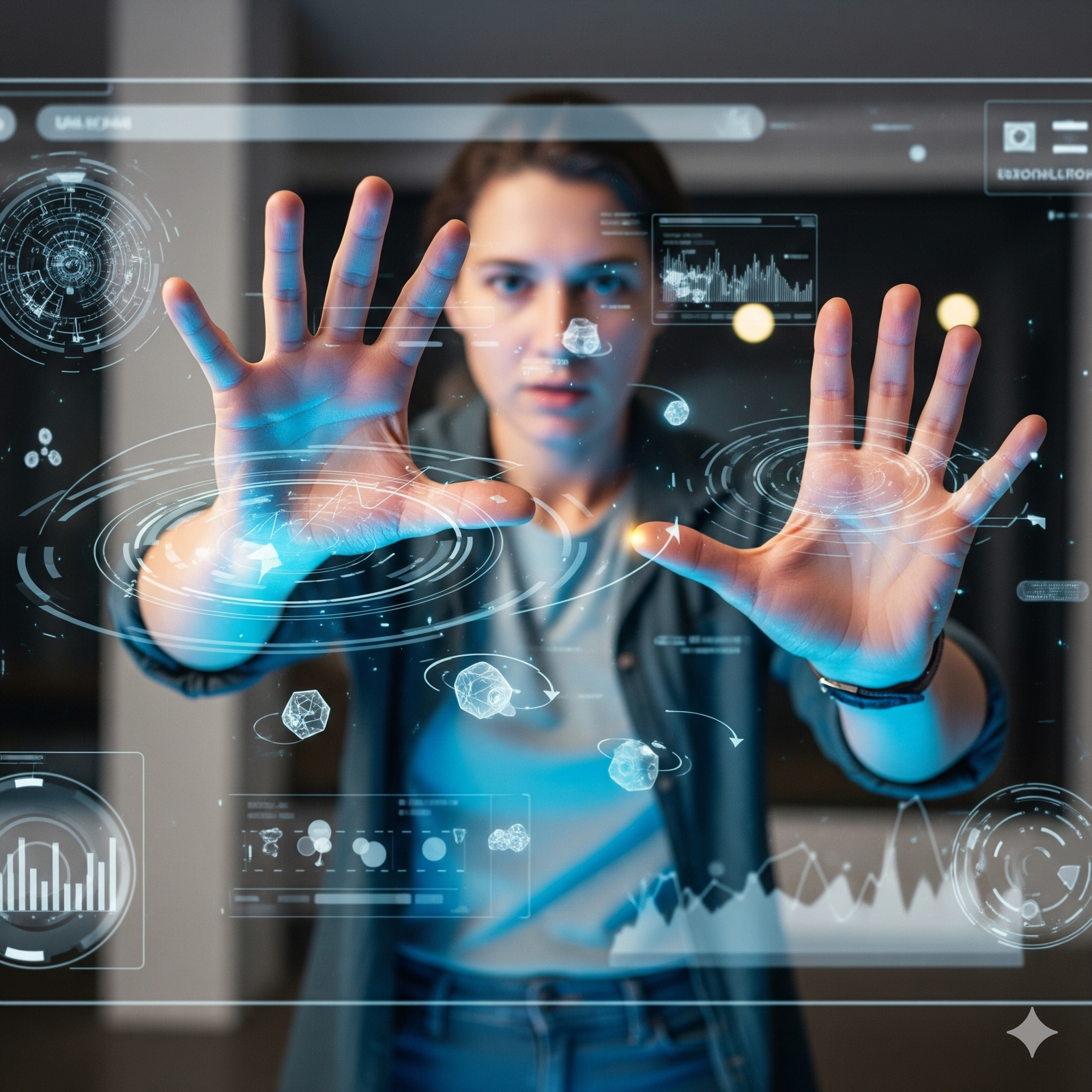
Based on my research, here are some recent developments in sensor fusion for enhanced gesture understanding:
Research and Development:
- Sensor Fusion for Wearable Mechatronic Devices: Research has explored using sensor fusion techniques to improve the control of wearable mechatronic devices used in assisted therapy. By combining electromyography (EMG) data, which measures muscle activity, and inertial measurement unit (IMU) data, which captures motion, researchers have developed user-independent gesture classification methods. This approach aims to create more natural interfaces that reduce calibration times for new users and improve the accuracy of gesture recognition, even with the stochastic nature of EMG signals.
- Low-Power Edge Devices and Neural Networks: There’s a push to develop hand gesture recognition systems that can be deployed on low-power edge devices, particularly for use in vehicles. These systems use time-of-flight and radar sensors to enhance human-machine interfaces while addressing privacy concerns associated with camera sensors. Recent work focuses on optimizing neural networks for embedded deployment, creating lightweight architectures that require significantly less memory while maintaining performance.
- Neuromorphic Computing and Sensor Fusion: Researchers are exploring fully-neuromorphic implementations of sensor fusion for hand gesture recognition. This involves integrating electromyography (EMG) signals and visual information from event-based cameras. The goal is to leverage neuromorphic technologies for real-time processing with low power consumption, overcoming the high computational costs associated with multi-sensor data fusion.
- Multimodal Gesture Recognition with Spatio-Temporal Features: Recent studies focus on improving the accuracy and efficiency of gesture recognition by fusing data from multiple sensors, such as vision, speech, inertial sensors, and electrodes. Approaches involve using deep learning models like YOLOv5 and incorporating 3D hand keypoint detection to capture spatio-temporal features.
- Wearable Ring for Gesture Recognition: A wearable platform has been developed that detects finger movements using audio and 3D acceleration. This sensor fusion approach uses audio generated by surface friction and acceleration data to detect and disambiguate gestures, with the aim of creating a small form factor device, potentially worn as a ring, for seamless human-computer interaction.
- Acoustic-Optic Sensor Fusion for Fine-grained Finger Gesture Recognition: A system called AO-Finger uses acoustic and optic sensor fusion to recognize fine-grained finger gestures. A wristband incorporating a modified stethoscope microphone and high-speed optic motion sensors captures signals from finger movements. A multimodal CNN-Transformer model is used for gesture recognition, achieving high accuracy in detecting gestures like flick, pinch, and tap, as well as enabling continuous swipe gesture tracking.
- IMU and AI for VR Gesture Recognition: Sensor fusion AI combines multiple IMUs to deliver high gesture precision in orientation and motion tracking. Advanced AI algorithms process sensor data on-device in real-time, virtually eliminating latency.
General Trends and Challenges:
- Multimodal Approach: Integrating data from multiple sensors (e.g., visual, inertial, bioelectrical) is generally considered preferable to relying on a single sensor modality.
- Real-time Processing: A key focus is on achieving real-time gesture recognition with low latency, which is crucial for applications like VR/AR and prosthetic control.
- Edge Computing: There’s a growing interest in running gesture recognition algorithms directly on devices (edge computing) to reduce latency and improve privacy.
- Robustness and Generalizability: A challenge remains in developing gesture recognition models that are robust to variations in users, environments, and gesture styles.
- Low Power Consumption: For wearable and mobile applications, minimizing power consumption is a critical consideration.
Commentary:
Sensor fusion is clearly a vibrant area of research and development for gesture understanding. The trend towards multimodal approaches is driven by the need for more accurate, robust, and reliable gesture recognition systems. The increasing emphasis on real-time processing and edge computing reflects the growing demand for gesture-based interfaces in applications like VR/AR, wearable devices, and human-robot interaction. While significant progress has been made, challenges remain in achieving generalizable models and deploying these technologies in real-world scenarios. It’s likely that we’ll see continued innovation in sensor fusion algorithms, hardware platforms, and applications of gesture recognition in the coming years.
Disclaimer: above content was searched, summarized, synthesized and commented by AI, which might make mistakes.
Offered by Creator: Telegesture lets you control your phone or other compatible devices from a distance through hand gestures leveraging advanced computer vision and machine learning techniques analyzing the device’s camera data in real time. It feels especially awesome when you project your device screen to a TV or projector, as if you are controlling the TV or projector from afar through Telekinesis power!

Leave a Reply