
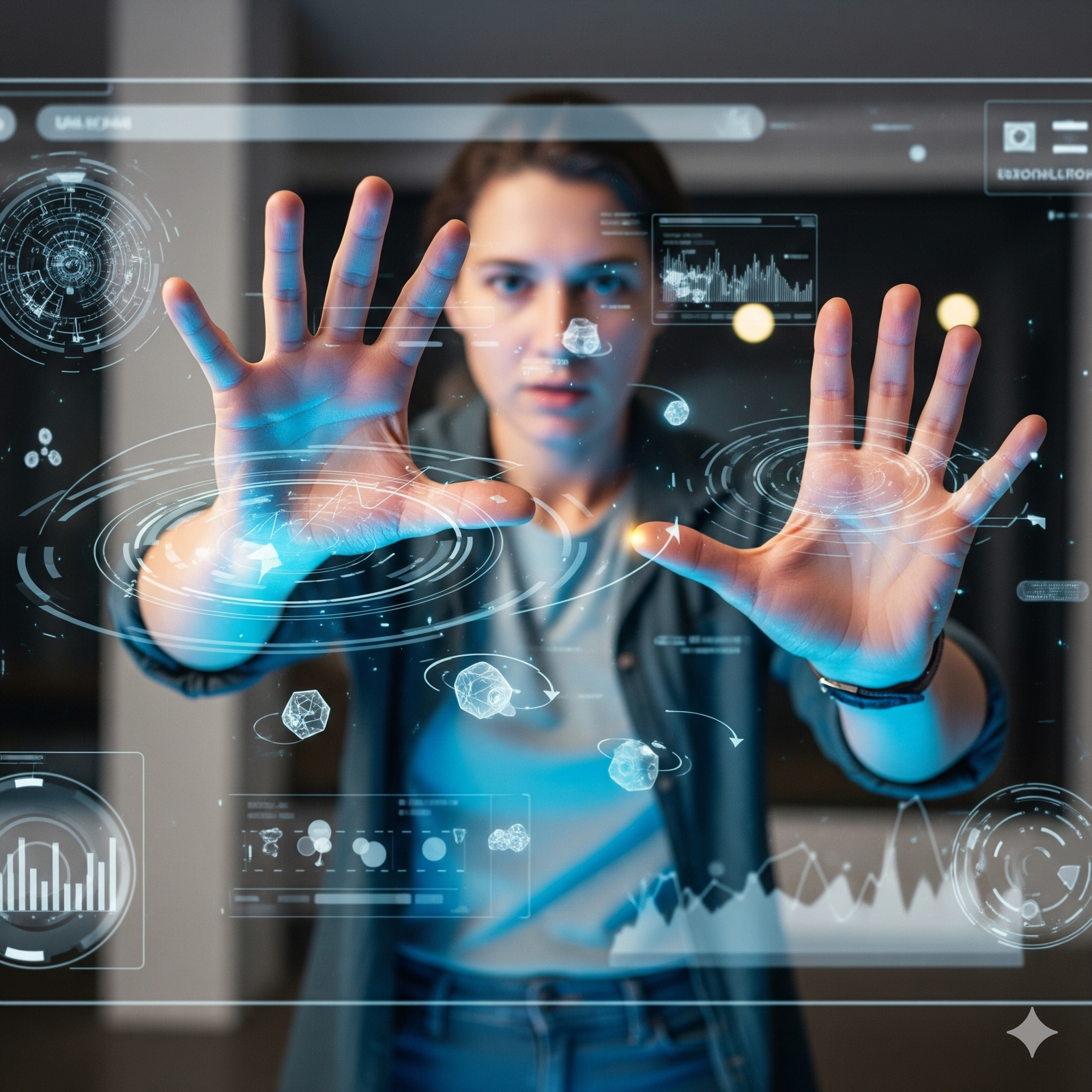
Privacy-Preserving Gesture Recognition focuses on enabling gesture recognition without compromising user privacy. This involves developing techniques that avoid storing or transmitting raw video data, often employing methods like federated learning or differential privacy. Recent developments in this area cover a range of approaches, including:
- RFID-based Systems: A gesture tracking system using frequency-hopping RFID signals aims to protect user privacy without sacrificing tracking efficiency and accuracy. The system uses frequency hopping to prevent eavesdroppers from obtaining raw RFID signals.
- Millimeter Wave and Thermal Imaging: Combining millimeter wave radar and thermal imaging enhances the precision of hand gesture recognition while addressing privacy concerns. Millimeter wave radar allays privacy concerns, and the thermal imager can detect hand images while maintaining privacy.
- Explainable Fuzzy Logic Systems: Research explores privacy-preserving gesture recognition using explainable Type-2 Fuzzy Logic Systems. These systems offer interpretability, which is beneficial in IoT applications.
- Federated Learning: Federated learning is being explored, where models are trained on decentralized devices, and a central server aggregates these local models. A secure aggregation protocol, FastSecAgg, enables the central server to average local models in a privacy-preserving manner.
- Differential Privacy: Differential privacy is utilized to guarantee privacy in theory, while maintaining accuracy. A method using differential privacy in the frequency domain has been proposed for face recognition.
- Abstraction-based Approaches: Architectures like Prepose protect privacy, security, and reliability by providing a high-level API for building gesture recognizers and only returning specific gesture events to applications, reducing the need to access raw data.
Commentary:
The field of privacy-preserving gesture recognition is actively evolving, driven by increasing concerns about data privacy and security. The diversity of approaches, from hardware-based solutions like RFID and millimeter-wave radar to software-based techniques like federated learning and differential privacy, highlights the multifaceted nature of the challenge. Integrating explainable AI methods, like Fuzzy Logic Systems, is a promising direction for building trust and transparency in these systems. As gesture recognition becomes more prevalent in various applications, including smart homes, AR/VR, and human-robot interfaces, research in this area will become increasingly important to ensure user privacy is protected.
Disclaimer: above content was searched, summarized, synthesized and commented by AI, which might make mistakes.
Offered by Creator: Telegesture lets you control your phone or other compatible devices from a distance through hand gestures leveraging advanced computer vision and machine learning techniques analyzing the device’s camera data in real time. It feels especially awesome when you project your device screen to a TV or projector, as if you are controlling the TV or projector from afar through Telekinesis power!

Leave a Reply